When you travel with food allergies, it is natural to become focused on yourself.
Will I be able to explain my allergies?
Will they understand me?
Will I be able to eat safely?
These are important questions, but they only consider one side of the conversation.
The perspective changed for me when I stopped asking how I would navigate the situation and started asking what another person would need in order to safely help me.
If someone handed me a card in a language I barely understood, what information would I need to confidently serve them?
That single question shaped every decision that followed.
An allergy card should do more than explain a medical condition. It should make it easier for another person to safely help you.
Without clear communication, a restaurant may decide your request is too uncertain to accommodate. Even worse, someone may misunderstand your needs while genuinely trying to help. Neither outcome is good for anyone involved.
This guide is not meant to be the perfect allergy card. It is an example of what can happen when you begin designing from the perspective of the person on the serving side of the interaction.
My hope is that it helps you communicate your own needs in a way that feels clear, respectful, and practical for everyone involved.
Designing From the Serving Side
Every country has different ingredients, cooking techniques, dining customs, and hidden sources of allergens. Rather than creating a generic allergy card, I wanted to design one around the situations I was most likely to encounter while traveling in China.
1. Communicate urgency
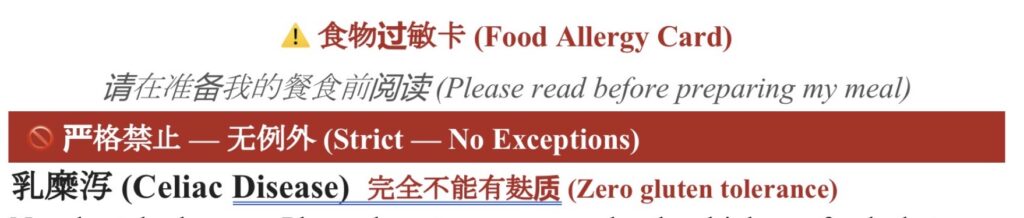
The first thing someone should understand is that this is important.
The card immediately identifies itself as a food allergy card, asks that it be read before preparing my meal, and clearly states that I have celiac disease with zero gluten tolerance.
My goal was to remove any uncertainty about whether the information should be taken seriously.
2. Reduce uncertainty
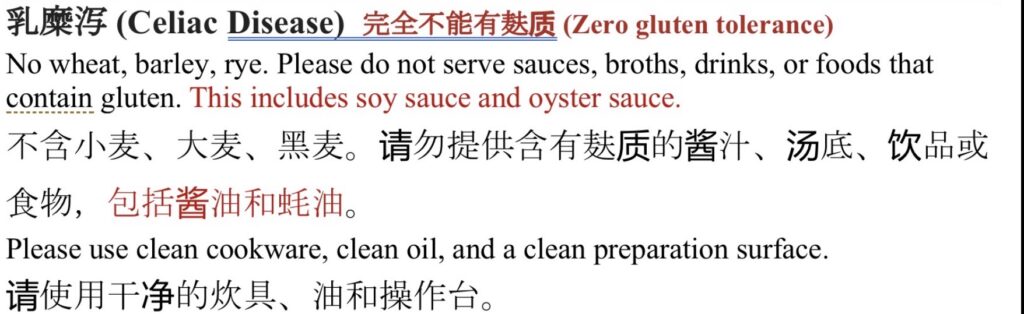
Simply saying “gluten free” leaves room for interpretation.
Instead, I identified common ingredients that frequently contain gluten in Chinese cuisine, including soy sauce and oyster sauce, because these are practical decisions someone preparing a meal may need to make.
I also requested clean cookware, fresh oil, and a clean preparation area to help reduce the risk of cross-contamination.
The more uncertainty I could remove, the easier it becomes for someone else to confidently help.
3. Make saying “yes” easier

One of my favorite design choices is the green section.
Rather than only listing foods I cannot eat, I also included examples of ingredients that are safe, such as plain meat, seafood, eggs, vegetables, rice, garlic, ginger, salt, pepper, cooking oil, and gluten-free sauces.
Instead of creating a list of restrictions, I wanted to provide a starting point for a safe meal.
Good communication should make solutions easier to see.
4. Prioritize what matters most

Not every dietary restriction carries the same level of risk.
For me, gluten is the highest priority because of celiac disease. Dairy is a separate medical restriction.
Keeping these sections separate helps communicate that priority while still asking that dairy not be included.
5. Leave the interaction with confidence

The last two messages may be the most important part of the entire card.
“If you are unsure, please do not serve this meal.”
Those words give someone permission to choose safety over guessing.
The final sentence thanks them for their care and attention.
I wanted the interaction to end with appreciation because helping someone eat safely takes extra thought and effort.
6. Communicate in more than one way
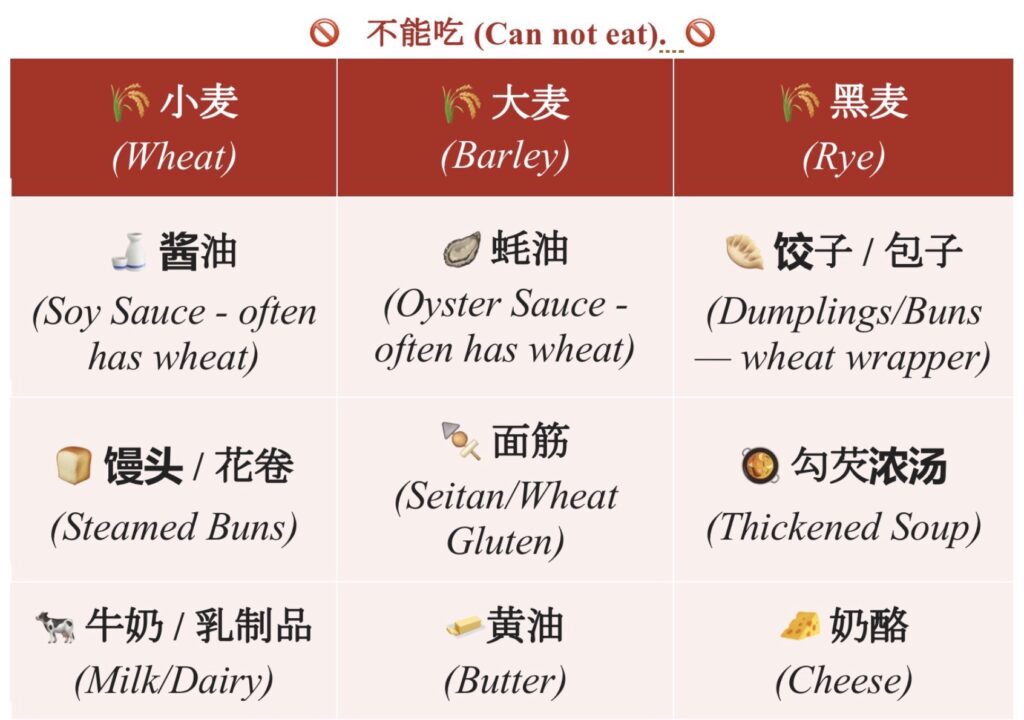
The reverse side reinforces the same message through simple visuals.
The images provide examples of foods that commonly contain gluten or dairy while repeating the most important safety instructions.
Whether someone prefers reading text or quickly recognizing pictures, the goal is the same. Important information should be easy to understand.
Could You Make Your Own?
Absolutely.
Whenever possible, I recommend working with a trusted translation service or professional medical translator. Your health and safety are worth the additional confidence that comes from having medical information translated accurately.
I also recognize that professional translation is not always accessible or affordable.
If that is your situation, I hope this project serves as a design guide rather than simply a template.
A translation tells someone what your condition is.
A thoughtfully designed card helps them understand what to do about it.
As you design your own, think beyond the diagnosis.
Ask yourself questions like:
- Which sauces, seasonings, or ingredients commonly contain my allergen where I am traveling?
- What cooking methods or shared equipment could increase the risk of cross-contamination?
- Can I include examples of foods that are safe instead of only listing restrictions?
- How can I encourage someone to choose safety if they are uncertain?
- Would simple images reinforce the message if there is still a language barrier?
The goal is not simply to translate your condition.
The goal is to make it easier for another human being to safely help you.
Is This Card Right for You?
This version was designed specifically for my own dietary needs:
- Strict gluten-free due to celiac disease
- Dairy-free due to a medical allergy
If your dietary needs are different, I hope the design process is still useful. Whether you purchase this card or create your own, my goal is the same. I want to make it easier for people to care for one another through thoughtful communication.
Important: Please review all translated medical information yourself before relying on it. Every person’s dietary needs are different, and you are responsible for deciding whether this card accurately represents your own requirements.
Download: Printable PDF containing three wallet-sized allergy cards per page.